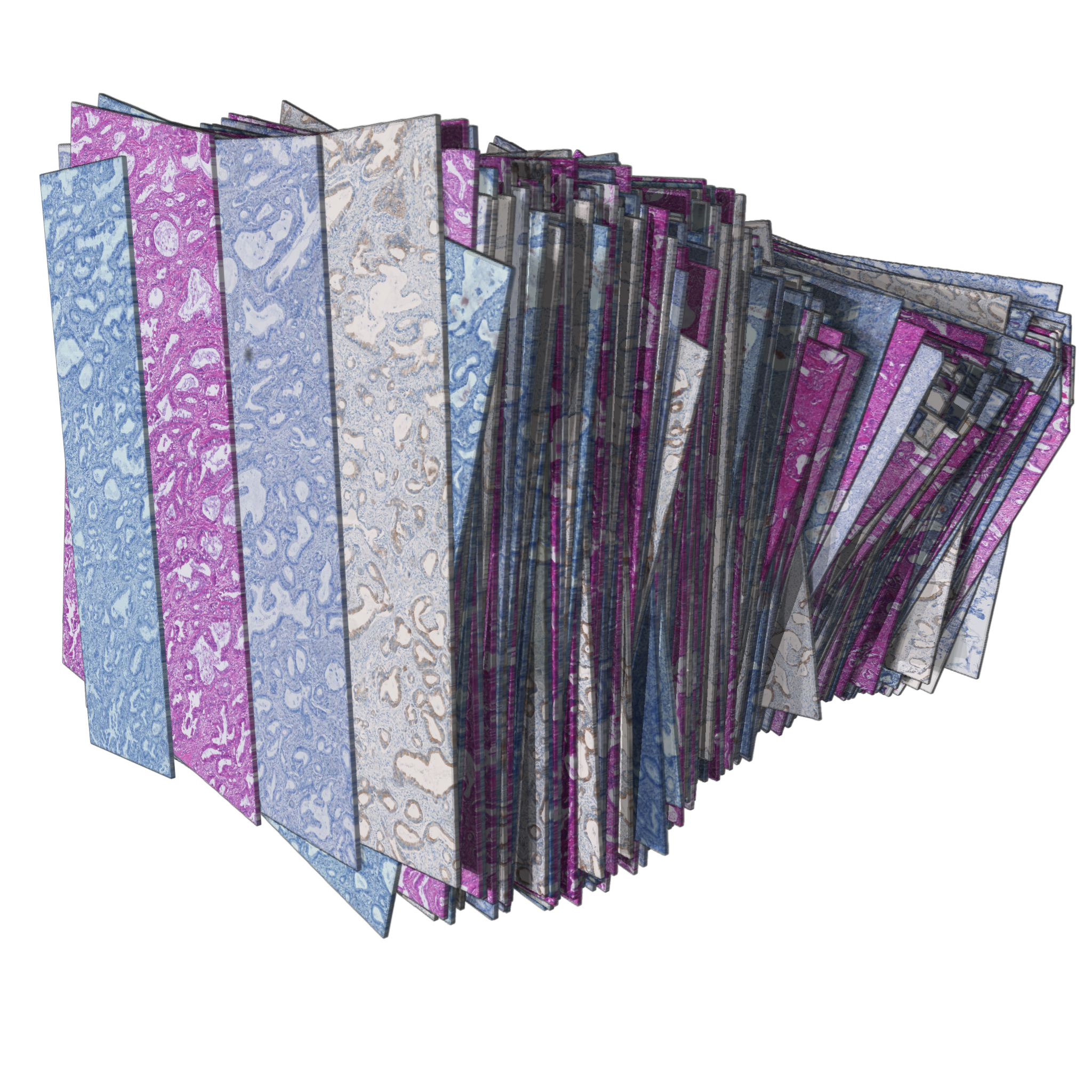
HistokatFusion brings cutting-edge image registration technology into computational pathology, and integrates different sources of information.
By seamlessly aligning multiple stained sections, HistokatFusion facilitates in-depth analysis, accelerates biomarker discovery, advances AI development, and supports the personalization of therapies.
The algorithm behind HistokatFusion was validated on a broad range of test data, including different public challenges on histological image registration:
CPU < 10s, GPU < 1s for accurate alignment of two consecutive sections
HistokatFusion can be easily integrated into your existing software solutions and workflows. It supports Python, C++, and serverless computed infrastructure on-demand.
HistokatFusion automates the image registration process, reducing manual interventions, streamlining diagnostic workflows, and enhancing overall patient care.
By introducing HistokatFusion, partners can unlock significant benefits for both clinicians and patients.
The platform also presents diverse opportunities for companies and vendors.
We provide the HistokatFusion software along with comprehensive support and integration assistance. Customers can obtain licenses and collaborate with us to develop customized solutions.
Upload slides (or use some of ours) and see the automatic image registration of whole slide images of HistokatFusion in action.
Demo application at histo.app
We believe that HistokatFusion is a vital technology that should be integrated into the clinical workflows of pathologists in the future. To achieve this, we are advancing its development in compliance with ISO EN 62304 standards. Additionally, we plan to expand and validate the fundamental support for fluorescence images, progressively creating a universal and validated tool for all relevant pathological image data.
We are also actively fostering the ecosystem for registering histological whole-slide images by collaborating with the community to develop tools and standards. This includes participating in large infrastructure projects such as BigPicture to ensure that registration becomes a key feature in future platforms and that suitable interfaces are created for its implementation.
P. Weitz et al.: The ACROBAT 2022 challenge: Automatic registration of breast cancer tissue. Medical Image Analysis, 2024
Lotz et al.: Comparison of consecutive and restained sections for image registration in histopathology. J Med Imaging (Bellingham), 2023
M. Balkenhol et al.: Optimized tumour infiltrating lymphocyte assessment for triple-negative breast cancer prognostics. The Breast, 2021
C. Mercan et al.: Virtual Staining for Mitosis Detection in Breast Histopathology. IEEE 17th International Symposium on Biomedical Imaging (ISBI), 2020
J. Borovec et al., ANHIR: Automatic Non-Rigid Histological Image Registration Challenge. IEEE Transactions on Medical Imaging, 2020
W. Bulten et al.: Epithelium segmentation using deep learning in H&E-stained prostate specimens with immunohistochemistry as a reference standard. Nature Scientific Reports, 2019